


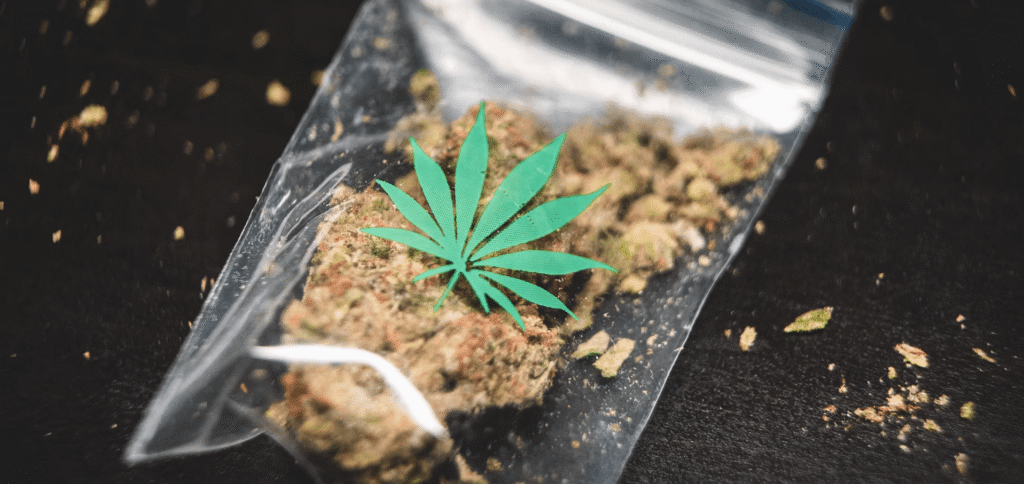
At the government’s initiative, Japan has decided to outright ban the manufacture, sale, possession and consumption of cannabinol (CBN). This is a cannabinoid derived from the cannabis plant, which was available in various forms (gummies, oils, biscuits). But why such a decision? We explain everything about this announcement in the rest of this article.
What is CBN?
Cannabis contains several dozen cannabinoids. Two occupy an extremely important place. These are THC (tetrahydrocannabinol), the psychotropic molecule of the cannabis plant, and CBD (cannabidiol).
More recently, other cannabinoids have “exploded” onto the market, such as CBG (cannabigerol) and CBN (cannabinol). The latter forms naturally through the oxidation of THC as the plant ages or is exposed to heat and light.
CBN is very mildly psychoactive. Like CBD, this molecule was primarily used for its supposed relaxing properties as well as its action on sleep.
Why CBN occupied a legal grey area in Japan
In Japan, legislation on so-called narcotic products is very clear. It specifically names the products or molecules that are banned from production or sale. Yet, until very recently, CBN did not appear on that list.
This “oversight” allowed thousands of professionals to develop their business around CBN by offering various products, ranging from classic gummies to oils and vaping liquids.
The market grew rapidly. The problem was that, given the state of the law at the time, abuses were observed. Products were of poor quality and dosages were sometimes significantly overestimated.
The incidents that triggered everything
Several incidents occurred as a result, pushing the authorities to act.
The Yamanashi Gakuin case and the first hospitalisations
In May 2025, a student at Yamanashi Gakuin University was seriously injured after jumping from his dormitory window on the second floor of his building. The investigation determined that the biscuits he had consumed, which contained very high doses of CBN, were likely behind a psychotic episode that led him to act. The incident, widely covered by Japanese media, shed light on effects that had until then been downplayed.
It subsequently emerged that this case was not isolated. The Japanese Ministry of Health confirmed that at least four hospitalisations had taken place between October 2024 and early 2026, all linked to the consumption of products containing very high doses of CBN.
Studies commissioned by the government highlighted the adverse effects of CBN at excessive doses. Cannabinol appears to be capable of inducing hallucinations as well as states of extreme excitation. The political decision was not long in coming.
Products at extreme doses at the heart of health concerns
The issue, ultimately, may not be CBN itself, but rather its dosages. Within the European Union, it is not uncommon to see CBD products containing 25, or even 50, and in rare cases up to 100 milligrams of CBN.
In Japan, doses were five to ten times higher. We do not yet have enough hindsight to understand how this molecule acts over the medium or long term at such dosages. In the absence of any legal framework governing concentrations, manufacturers and importers were able to market increasingly high-potency products, with no obligation for standardised labelling or prior health checks.
The ban on CBN in Japan
On 19 March 2026, the Japanese Ministry of Health, Labour and Welfare officially announced the classification of CBN as a “designated substance” (指定薬物, shitei yakubutsu) under the Pharmaceutical and Medical Devices Act. The effective date was set as 1 June 2026.
In practice, this classification prohibits:
- the manufacture of CBN-based products
- their importation into Japanese territory
- their sale, in any form (physical shops, online commerce)
- their possession
- their consumption
In accordance with Japanese law, the sanctions for offenders can be extremely severe. Infractions carry penalties of up to five years’ imprisonment.
Since the start of this month of June, there is no longer any possibility of extending deadlines. Companies have been ordered to destroy their stocks, while consumers still holding CBN products must dispose of them as soon as possible.
One exception, however
One exception does exist. The government has decided to allow people suffering from a serious medical condition who cannot be treated with conventional therapy to access CBN products.
A specific administrative procedure must be followed to obtain authorisation from the executive. The criteria remain very restrictive, and obtaining approval is a path strewn with obstacles.
What do tourists and foreign residents risk?
The law passed by the Japanese government makes no distinction between people based on their status or origin.
More specifically, this means that any individual travelling to or present in Japan and in possession of a CBN-enriched product is liable to the sanctions mentioned above, even if the product in question was legally purchased abroad.
For example, a French person who legally purchases a CBD and CBN oil in France will not be able to travel to Japan with that product, on pain of being arrested and, ultimately, prosecuted.
What future for legal cannabinoids in Japan?
The ban on CBN by the Japanese authorities does not concern CBD products, which remain legal in Japan, provided they contain absolutely no trace of THC. This refers to broad spectrum products (covering a wide range of cannabinoids), as opposed to full spectrum products (covering the complete range of cannabinoids and containing THC). In addition, neo-cannabinoids such as HHCH, HHCP and others are strictly prohibited.
In brief, on CBN in Japan
The Japanese CBD market is what it is. It is a regulated, restrictive market. The fact that there was no clear position on CBN was an anomaly that the government has now corrected, choosing however to ban everything outright rather than leaving the door open to better-formulated products with more controlled production. CBN is probably not the last cannabinoid to fall victim to this policy, as CBG and other molecules could soon face tighter regulation.