


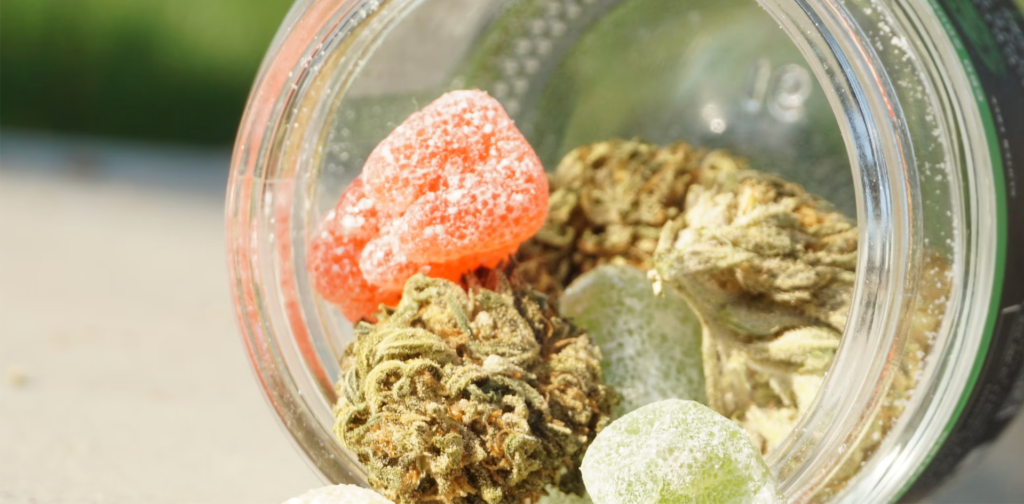
Everything you need to know about the ban on edible CBD products
This decision, enforced since 15 May 2026, has come as a real thunderbolt for the industry. On that date, the Direction générale de l’alimentation (DGAL) chose to strictly enforce the European Novel Food regulation (EU 2015/2283). The result? Edible CBD products have quite simply become prohibited.
This decision is a serious blow to the sector. More than 2,000 specialist shops sell CBD in France, in a market estimated to be worth between 600 million and 1.2 billion euros in 2025. CBD sweets and gummies, food-grade oils and CBD infusions have all been removed from shelves as a consequence.
Why does 15 May 2026 mark a turning point for CBD in France?
Where CBD is concerned, France has always sat between two camps. On one side, some voices call for a strict ban on products, while others take a more open stance and advocate for the decriminalisation of cannabis consumption.
The Novel Food regulation
First and foremost, CBD is not banned in France. However, the legislation of 15 May 2026 imposes new obligations on businesses operating in this market.
More specifically, regulation (EU) 2015/2283, known as the Novel Food regulation, requires that any food ingredient not significantly consumed in Europe before 15 May 1997 must obtain prior authorisation before being placed on the market.
This is the case for the cannabinoids found in extracts of Cannabis sativa L. (hemp). CBD is therefore regarded as a novel food that must be authorised before it can be sold freely on the French and, more broadly, European markets. To reach that point, it must first receive approval from the European Food Safety Authority (EFSA), something that has not yet happened.
The DGAL signals the end of tolerance for industry professionals
On 15 April 2026, the Direction Générale de l’Alimentation (DGAL) convened the main trade unions and federations of the hemp industry to confirm that the Novel Food regulation would be strictly enforced from 15 May 2026.
From that date, initial inspections were carried out to ensure that wholesalers, e-commerce websites, pharmacies and other retailers were scrupulously complying with the legislation in force.
Where non-compliance is identified, the authorities reserve the right to initiate legal proceedings.
Which CBD products are now banned from sale?
The legal test is now relatively straightforward. If a CBD product is intended to be ingested, it falls within the scope of inspections.
The following products are currently banned from sale:
- CBD oils sold as food supplements
- CBD-infused gummies, sweets and lozenges
- CBD capsules and softgels
- CBD infusions, teas and herbal drinks
- Beverages made with CBD
For some businesses, this can represent between 10 and 15 per cent of turnover disappearing overnight. More dramatically still, certain brands that had focused exclusively on producing CBD infusions, for instance, may not survive.
A few grey areas remain
As is often the case with CBD, certain grey areas persist. Chief among them are sublingual oils. If they are labelled for application under the tongue rather than ingestion, they may in theory fall under cosmetic or non-food use. However, this remains open to interpretation.
The same applies to hemp leaf infusions. These are permitted. By contrast, herbal teas made from hemp flowers (as opposed to leaves which is an important distinction) are banned.
Which CBD products remain legal and permitted?
Not all CBD products are prohibited. Products intended for vaporisation, CBD flowers, as well as cosmetics and topically applied products such as balms and creams are not affected by the strict enforcement of the law, as they fall outside the scope of the Novel Food regulation.
Furthermore, it cannot be ruled out that the French government may reverse course in the coming weeks or months under pressure from the industry. The Union des Professionnels du Cannabis Bien-être et Détente (UPCBD) has, for example, launched a petition and several amendments have been tabled in the National Assembly in defence of the sector.
A number of legal challenges have also been filed, invoking in particular the Kanavape ruling of the Court of Justice of the European Union, though some legal specialists consider its relevance here to be rather limited. The Kanavape ruling only governs national restrictions on intra-European trade. It does not exempt products from the requirement to obtain Novel Food authorisation.